
Bradford S. Waddell, MD
Fellowship Trained, Board Certified Orthopaedic Surgeon
Dallas Hip and Knee Replacement Specialist
Hip Pain
Where is the pain?
Hip pain can occur for a variety of reasons. These can include back problems, bursitis, muscle injury, tight muscles, and problems inside the joint (such as arthritis). The location of the pain is usually an indicator of what is causing the pain. There are three typical locations of "hip" pain and each has a typical cause of that pain. There are many structures in the area of the hip, making it possible that there is more than one cause for pain in the area of the hip. However, below is a quick review of the most common causes of "hip" pain by location.
Pain that occurs mostly on the posterior aspect of the hip, in the buttock area, is usually caused by the back. This pain can also radiate down the buttocks and posterior leg to the thigh, calf and foot. While the pain can be coming from the hip, this pain is usually addressed by a back physician. This pain, as previously mentioned, can be coming from the hip, so it is perfectly reasonable for Dr. Waddell to evaluate you to determine if your hip is the cause of this pain.
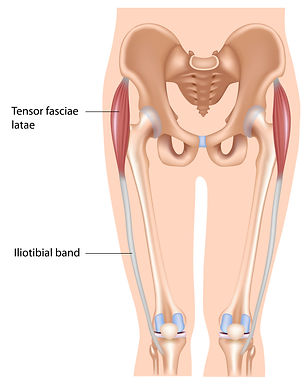
Pain that occurs on the outside of the hip, also know as laterally, is usually from greater trochanteric bursitis. The greater trochanter is a large "bump" of the femur bone that comes into contact with the Iliotibial (IT) band and tensor fascia latae (TFL) muscle. There is a bursa between the IT band/TFL and the greater trochanter that lubricates the two so they glide smoothly across each other. Sometimes this bursa becomes inflamed and irritated and causes pain. This pain is a sharp pain on the outside (lateral aspect) of the hip that is made worse with activity and hurts to touch or lay on that side. This type of hip pain can be from the hip joint itself, which is why evaluation is necessary. Further, this pain can be treated in most cases with rest, anti-inflammatories, and physical therapy. A steroid injection is sometimes used to calm the inflammation down.
Pain that occurs in the front of the hip in the groin area is usually from the hip joint itself, but can have other causes as well. These other causes can include hernias, muscle strain, back conditions and others. Pain generated from the hip itself is usually sharp and stabbing at times and dull and achy at others. It is usually made worse with turning the toe inward or outward. The pain can be caused by a number of factors, these include: age, activity, genetics, previous injury, and many others. Patients typically referred to my clinic are suffering from arthritis and this is the main cause of pain that occurs in the groin (or the front of the hip) seen in my practice.
No matter where your pain, Dr. Waddell will use a detailed history, physical exam and x-rays to determine the cause and treatment for the pain.
Hip Anatomy
The hip is a "ball-and-socket" joint made up of the upper-most part of the femur (femoral head) and a part of the pelvis called the acetabulum (socket). The hip is held together by the ball and socket conforming together and also by very strong ligaments. The hip has a very wide range of motion and can essentially move in all directions, allowing us to walk, squat, and many other activities with relatively little trouble.
Specific Causes of Hip Pain
There are many causes of "hip" pain. As discussed above, the pain can be from the back, bursitis, and many different problems inside the joint. The cause of hip pain can vary with age as well.
While it is typical that as we progress in age, we more commonly suffer from degenerative changes to the hip, such as arthritis, we are now seeing a significant rise in younger patients with severe degenerative conditions of the hip. A few of these problems are discussed below.
Back Pain
It is very important to consider the back as a potential cause of hip pain. The spine holds the spinal cord and sends out the large nerves to the lower extremity. Nerves function to relay messages to the body from the brain (like telling muscles to move) and also relay messages back to the brain (like telling the brain somewhere is hurting). Sometimes an injury or problem in the back can cause the nerves to send pain signals down to the area where that nerve controls. This is why a back problem or injury can present as pain somewhere else.
Muscle Strain
Muscle strains occur when a muscle is injured, usually seen in the setting of trauma or an injury. This pain can be anywhere around the hip and usually begins to get better with time and avoiding activities that cause the pain.
Greater Trochanteric Bursitis
As mentioned above, pain that occurs on the outside (lateral aspect) of the hip is usually caused by bursitis of the greater trochanter. As a review from above, the bursa is a fluid filled sac that sits between the IT Band/TFL muscle and the greater trochanter. This bursa can become inflamed and cause pain on the lateral (outside) of the hip. This pain can be reproduced by pushing on the greater trochanter and usually keeps you from sleeping on that side (if you are a side sleeper). The pain is usually sharp and will sometimes radiate down the side of the leg to the knee. Greater trochanteric bursitis can occur in any age range. The treatment is usually avoiding activities that hurt, anti-inflammatories, physical therapy and sometimes a steroid injection.
Labral Tear
The labrum is a strong circular piece of cartilage that surround the hip socket (acetabulum) and acts to seal and strengthen the hip joint. In younger patients, the labrum is usually torn in a trauma situation. In older patients, the labrum can wear out and appear as a tear on MRI. Labral tears that are torn in an injury are usually painful. This pain is worse with deep squats and with internal and external rotation of the hip. Degenerative tears are usually less painful and occur in conjunction with arthritis. The treatment for a labral tear is based on the symptoms and the individual patient.
Arthritis
Arthritis of the hip, whether Rheumatoid arthritis or Osteoarthritis, is usually a painful condition where the cartilage has worn away in the joint. Young patients can have arthritis as well, and this is becoming more common. Arthritis is defined as the damage and loss of normal cartilage. In Osteoarthritis, this damage and loss if from wear and tear. In Rheumatoid arthritis, and other inflammatory arthritis conditions, the cartilage loss is from the body attacking itself and causing loss of cartilage. Arthritis of the hip usually begins as a nagging pain in the groin or surrounding the hip that is worse after activity. The pain then progresses to hurting with most activities and limits activities. Treatment for arthritis usually begins with non-operative therapy, such as anti-inflammatories, physical therapy, and possibly injections. Surgery is usually reserved for severe cases and/or those cases that fail non-operative therapy.
How to Diagnose the Cause of the Pain
The most important tool Dr. Waddell uses to determine the cause of your pain is listening to you as the patient. You know your body best and it is important for a surgeon to fully understand how the pain began, has progressed and has been treated so far. It is very important to know what makes the pain better and what makes it worse. After a detailed history, Dr. Waddell will perform a detailed physical exam which is essential in the diagnosis of your condition.
The next step in the process will be X-rays. Many patients have taken previous X-rays and while those sometimes will work, Dr. Waddell has specific X-ray views that studies have shown to be superior than standard X-ray views. If your previous X-rays did not include the specific views, then it will be necessary to get these X-rays so he will have the best chance to accurately diagnose your condition.
Treatment Options
Nearly all orthopedic treatments begin with similar methods. The first step is to avoid activities that hurt. When this becomes impossible due to the pain affecting your daily activities, then it is time to be evaluated and treated. Treatment options include anti-inflammatory medications, physical therapy, injections, and eventually surgery if it is necessary. Dr. Waddell's goal is to get each patient back to full function and pain free while reserving surgery only when non-operative methods fail.


Greater Trochanter
Greater Trochanter under the muscle/tendon

